Modern IT Upskilling and Cloud Delivery Guide for Enterprise Teams in Japan
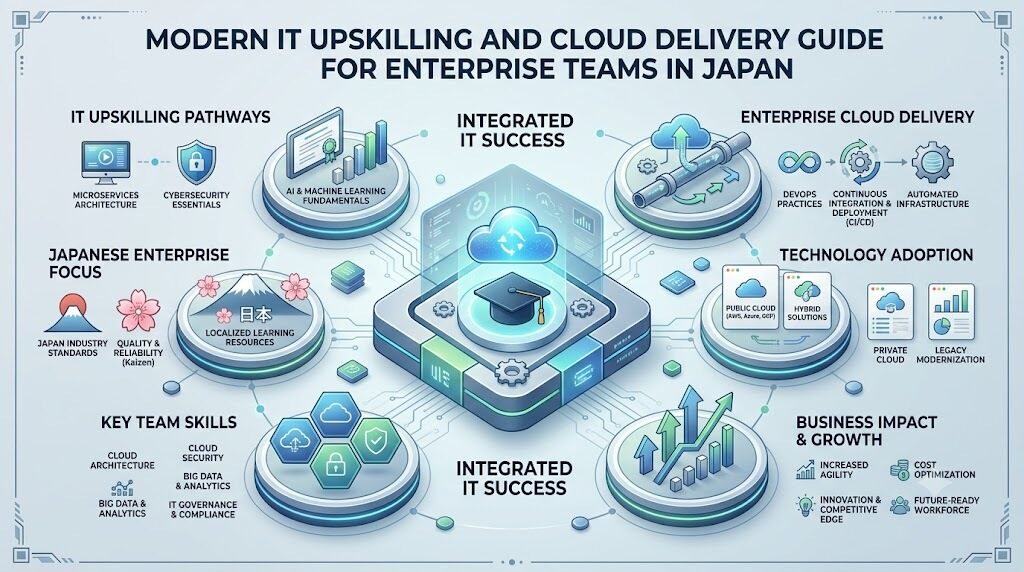
What is DevOpsSchool.jp
DevOpsSchool.jp is an IT training and consulting platform made for modern teams. It focuses on three key areas: enterprise skill development, hands-on implementation, and continuous technical support in Japan.
Many corporate programs only teach theory from books. In contrast, DevOpsSchool.jp uses real-world labs where engineers practice on live cloud environments. They help organizations replace slow manual tasks with clean, automated workflows. Their certified experts work side by side with your developers and operations staff. This hands-on method helps your team gain deep confidence quickly.
Building Strong Internal Engineering Skills
Modern software delivery needs close teamwork between developers and operations staff. When teams work in separate silos, releases move slowly. Bugs also slip into production more often.
Structured corporate education fixes this problem by teaching standard automation practices across the whole department. A focused program like DevOps 研修 helps engineers master continuous integration and continuous delivery pipelines. In these pipelines, code is tested and packaged automatically whenever a developer saves a change.
Teams learn how to catch bugs early, write automated tests, and release updates in small batches. Investing in high-grade DevOps corporate training Japan ensures your internal staff can handle fast product cycles. Your engineers do not just read slides. They run build servers, manage code branches, and fix broken pipelines in safe practice labs. As a result, your company ships features faster and avoids costly release outages.
Hands-On Expert Guidance for Transformations
Adopting modern engineering practices is more than just buying new software licenses. It requires changing daily habits, team communication, and release approvals. This transition can feel tough for traditional IT departments.
Working with external specialists speeds up the whole journey. Choosing DevOps コンサルティング brings seasoned advisors straight into your technical discussions. These experts look at your current delivery setup and point out bottlenecks. They show you where manual handoffs waste hours of staff time.
By hiring an experienced DevOps consultant Japan, your team receives a clear, step-by-step roadmap tailored to your company goals. The consultant helps your architects pick the right cloud tools and set up standard branching models. They also teach your team leads how to run blameless post-mortems after incidents. This expert guidance helps your business save money and skip common beginner mistakes.
Mastering Cloud-Native Infrastructure Tools
Modern applications run best when packaged inside lightweight software units called containers. A container holds your application code together with all the files it needs to run. This setup prevents the common problem where code works on a laptop but fails on a production server.
Managing hundreds of containers by hand is impossible. This is why teams use Kubernetes, a tool that automates container scheduling, scaling, and recovery. Through targeted Kubernetes 研修, your engineers learn how to set up clusters, configure worker nodes, and direct web traffic. If a container crashes, Kubernetes starts a new one automatically. Your engineers practice these exact recovery tasks in interactive lab sessions.
Teams also need a fast, reliable way to create cloud networks, storage, and virtual servers. Writing infrastructure setup steps into text files is called Infrastructure as Code. Through practical Terraform 研修, engineers learn how to write simple configuration files to build cloud resources. Terraform reads these files and sets up the whole infrastructure in minutes. If you need a test environment, you run one command instead of clicking web consoles for hours. This method cuts human setup mistakes down to zero.
Core Technical Training Tracks
The table below outlines the core technical tracks enterprise teams use to modernize their software delivery.
| Training Domain | Core Tool / Focus | Business Benefit | Target Team |
| DevOps Core | Git, Jenkins, GitLab CI | Faster releases and fewer code bugs | Developers and Sysadmins |
| Containers | Docker, Kubernetes, Helm | Consistent environments and automatic scaling | Cloud Engineers and App Teams |
| Infrastructure as Code | Terraform, Ansible | Fast, repeatable cloud setup with zero manual drift | System Architects and Cloud Ops |
| Reliability | Prometheus, Grafana, SLOs | High uptime and clear system health data | SREs and Operations Staff |
| Pipeline Security | Trivy, SonarQube, Vault | Safe code delivery with early vulnerability checks | Security and Delivery Teams |
| Machine Learning Ops | MLflow, Kubeflow | Rapid deployment and live monitoring of AI models | Data Scientists and ML Engineers |
Ensuring System Reliability and Uptime
Keeping online services running smoothly is critical for enterprise revenue and customer trust. When an important business portal goes down, the company loses money and credibility every minute.
Site Reliability Engineering, or SRE, applies software engineering methods directly to system operations. Enrolling your engineers in SRE 研修 teaches them how to set clear service level goals. They learn to track error rates, response latencies, and server traffic with tools like Prometheus.
Engineers also learn how to create smart alerts that notify staff only when user experience drops. This stops alert fatigue so engineers can rest well and focus on real issues. Most importantly, teams learn how to run incident drills. They practice recovering failed databases and rerouting traffic during mock outages. These exercises turn emergency panic into calm, routine engineering work.
Integrating Security into Daily Delivery
In traditional IT teams, security reviews happen right before software goes live. This late check often uncovers deep vulnerabilities, which forces teams to delay launches by weeks.
DevSecOps solves this problem by moving security checks to the very start of the software cycle. Through dedicated DevSecOps 研修, engineers learn how to place automated scanners inside everyday delivery pipelines. Every time code is checked in, the pipeline tests it for known vulnerabilities, weak libraries, and exposed passwords.
Developers see security warnings immediately on their screens while the code is fresh in their minds. They fix issues on the spot before code ever merges into main branches. Teams also learn how to store database secrets safely without leaving passwords in plain text files. This proactive habit protects customer data without slowing down your release train.
Scaling AI and Machine Learning Pipelines
Many enterprises in Japan build machine learning models to analyze data and predict trends. However, moving an AI model from a data scientist's notebook into a live customer application is hard.
Models often behave strangely when hit with real-world user data. Teams need automated systems to retrain, test, package, and deploy these models smoothly. Comprehensive MLOps 研修 teaches teams how to connect data pipelines with automated release workflows.
Engineers discover how to track model versions, compare prediction accuracy, and watch for data drift over time. If a live model starts giving bad answers, the automated system rolls back to the previous safe model version. This structure lets your data scientists focus on building better algorithms instead of babysitting live servers.
Continuous Technical Assistance for Enterprise Teams
Even well-trained internal teams run into sudden production problems and complex architectural questions. Cloud platforms update their tools often, and legacy software integrations can bring unexpected hurdles.
Having reliable DevOps support Japan gives your engineering leaders great peace of mind. On-demand assistance offers your staff direct access to senior practitioners for difficult code reviews, pipeline fixes, and cluster tuning.
When your team faces a strange network bug in Kubernetes, external support specialists help you debug the issue quickly. They also review your cloud configurations to help you cut unnecessary infrastructure costs. This ongoing backup acts as a safety net, so your internal staff keeps moving forward with confidence.
Evaluating Training and Consulting Providers in Japan
Choosing the right technical partner makes a huge difference in your company results. Use this practical matrix to review potential partners.
| Evaluation Factor | What to Look For | Why It Matters for Japanese Enterprises |
| Lab-Based Learning | Real cloud sandboxes, not just lecture slides | Engineers learn best by fixing real broken systems. |
| Bilingual Delivery | Instruction in Japanese or simple business English | Clear communication ensures all staff grasp deep technical concepts. |
| Trainer Experience | Instructors who work as active production architects | Practical tips beat textbook theory during messy migrations. |
| Custom Curriculum | Courses tailored to your specific cloud stack | Saves time by focusing strictly on tools your business uses. |
| Post-Training Support | Q&A forums, code reviews, and follow-up clinics | Helps engineers apply newly learned skills to live company projects. |
Real-Life Scenarios: How Teams Transform
Real organizations face different challenges as they modernize their technology stacks. Here are three common scenarios:
Shifting from Legacy Virtual Machines to Containers: A banking IT division ran core services on old virtual servers. Updates took four hours of manual work every weekend. The team joined a hands-on container training program. They learned how to package their applications and deploy them to managed clusters. Release times dropped from four hours to five minutes, and weekend work stopped completely.
Automating Manual Testing and Code Deployment: An e-commerce engineering unit had developers waiting three days for QA testers to run tests manually. By adopting automated build pipelines, the group automated unit testing, security scans, and environment deployments. Developers now see test results in six minutes. They push code safely to production multiple times a day.
Improving System Stability During Peak Sales: A retail firm suffered website crashes during holiday flash sales. The operations crew took an intensive site reliability course. They added real-time dashboards and automated horizontal pod scaling. When traffic spikes, the platform adds new server capacity automatically. Outages during busy shopping events dropped to zero.
Common Mistakes to Avoid in Tech Transformations
Transforming your IT operations takes careful planning. Avoid these eight frequent mistakes to keep your program on track:
Buying Tools Before Training People: Many companies buy costly cloud software licenses first. But tools cannot fix broken workflows if your staff does not know how to use them well.
Skipping Hands-On Lab Work: Listening to lectures does not build real engineering skills. Engineers need practical labs where they type commands, deploy containers, and fix errors.
Ignoring Observability and Monitoring: Teams often deploy new apps without tracking system health metrics. Without good dashboards, you only discover outages when angry customers call your support line.
Treating Security as an Afterthought: Leaving security checks until the final day before release leads to long launch delays. Integrate automated vulnerability checks early in your build pipelines.
Changing Everything on Day One: Trying to rewrite all your systems at once creates chaos and confusion. Pick one small, non-critical application first. Learn from it, then scale up.
Forgetting Cultural Collaboration: DevOps is about breaking down walls between teams. If developers and system operators do not share common goals, automation tools will not save you.
Neglecting Real Cloud Cost Management: Spinning up cloud resources with automation is very easy. But if nobody cleans up unused test servers, your monthly cloud bill will explode.
Failing to Measure Progress: You cannot improve what you do not measure. Track real metrics like deployment frequency, failure rates, and recovery time to verify your team growth.
How DevOpsSchool.jp Can Help
DevOpsSchool.jp provides practical learning roadmaps and consulting built specifically for enterprise teams in Japan. They understand the exact operational standards and quality requirements that local enterprises expect.
Their programs feature certified instructors who bring years of real production experience into every session. Instead of abstract lectures, they deliver hands-on masterclasses in containers, automation pipelines, cloud architecture, and security. Delivery formats remain completely flexible. You can choose private corporate bootcamps, interactive virtual workshops, or on-site advisory consulting. DevOpsSchool.jp works closely with your engineering managers to build custom learning paths that match your exact company tool stack.
A Simple 7-Step Upskilling and Advisory Roadmap
Follow this clear seven-step path to plan your team learning journey:
Goal: Define your business targets clearly. Decide whether you need faster release cycles, better system uptime, or lower cloud hosting costs.
Search: Look for training and advisory partners that specialize in hands-on enterprise IT practices and modern cloud tools.
Shortlist: Select two or three providers that offer live practice labs, active industry practitioners, and flexible delivery schedules.
Compare: Review course syllabi, lab architectures, trainer credentials, and pricing models side by side.
Ask: Speak directly with the instructors. Ask how they customize practice exercises for your specific applications and cloud platforms.
Verify: Check real enterprise reviews, client references, and case studies to ensure the provider delivers high-impact results.
Decide: Pick your learning partner, schedule your team sessions, set baseline success metrics, and kick off your hands-on transformation.
Frequently Asked Questions (FAQ)
Question 1: Why should Japanese enterprises train their internal teams instead of outsourcing all cloud tasks?
Outsourcing every cloud task creates heavy dependencies on external vendors. It slows down daily product updates and increases long-term engineering costs. When you build strong technical skills inside your own company, your staff can fix bugs quickly, deploy software features on demand, and protect valuable company knowledge. Internal engineering excellence keeps your business agile and ready for modern market competition.
Question 2: What is the primary difference between traditional system administration and modern DevOps practices?
Traditional system administration relies heavily on manual server setups, long change approval meetings, and separate operations teams. Modern DevOps practices use automation code to build infrastructure, test software, and run deployments continuously. Developers and operations engineers work together as one united team. This teamwork allows organizations to release high-quality software updates rapidly, safely, and without disruptive manual weekend work.
Question 3: How long does it usually take for an enterprise engineering team to adopt container tools?
Most enterprise teams need four to eight weeks of focused learning and guided lab practice to master basic container workflows. During this time, engineers learn how to package applications inside Docker images, manage networking, and deploy workloads onto Kubernetes clusters. Reaching full production maturity across all company projects usually takes a few months of continuous hands-on practice.
Question 4: Can non-technical IT managers benefit from high-level enterprise DevOps training sessions?
Yes, IT managers gain huge value from executive and managerial training tracks. These focused sessions teach leaders modern delivery vocabulary, core automation metrics, team culture improvements, and realistic transformation timelines. With this foundational knowledge, engineering managers can remove daily delivery bottlenecks, support their technical staff effectively, and make smart software procurement choices that align with strategic business goals.
Question 5: Why is Infrastructure as Code with Terraform safer than manual cloud console management?
Manual cloud setup through web consoles often causes human typos, forgotten security rules, and untracked environment differences. Infrastructure as Code lets engineers define servers, networks, and databases inside clear, human-readable text files. Teams review these files using version control before applying any changes. Terraform automates the entire provisioning process, ensuring every testing and production environment stays identical, documented, and safe.
Question 6: How does Site Reliability Engineering help businesses reduce costly application downtime?
Site Reliability Engineering establishes clear service level objectives based on real customer experience. Instead of reacting to random complaints, teams track error budgets, response times, and server capacity with automated monitoring tools. SRE also introduces blameless post-incident reviews and emergency recovery drills. These proactive practices help engineers discover system weaknesses early and fix underlying root causes before major revenue-impacting outages happen.
Question 7: At what stage in the development pipeline should automated security scans take place?
Automated security scans should take place as early as possible in the daily development pipeline. This early approach is called shifting left. Every time an engineer pushes new code to a repository, automated scanners should check for vulnerable software libraries, weak configurations, and plain text secrets. Catching vulnerabilities early allows developers to fix security flaws in minutes before deployment.
Question 8: What specific business problems does MLOps solve for companies investing in machine learning?
MLOps solves the painful disconnect between data science experiments and live customer production systems. Without good automation, deploying machine learning models requires manual file copying and custom scripts that break easily. MLOps automates model testing, packaging, deployment, and performance monitoring. It alerts engineers when incoming user data drifts, ensuring prediction models remain accurate, reliable, and compliant over time.
Question 9: What should an enterprise look for when selecting a specialized technical consultant in Japan?
Look for consultants with proven track records in live production migrations and deep knowledge of enterprise cloud environments. The right consultant should offer clear communication, hands-on architectural reviews, and customized roadmaps rather than generic advice. They must be willing to work directly with your internal staff, transfer valuable technical skills, and build long-term engineering confidence within your organization.
Question 10: How do hands-on practice labs help engineers retain complex cloud infrastructure concepts?
Reading books and watching recorded lectures only provides theoretical understanding. Engineers truly learn complex cloud systems by running commands, observing real system behavior, and troubleshooting errors inside live sandbox environments. Hands-on labs let staff make mistakes safely, discover why specific configurations fail, and learn the exact recovery steps needed to keep high-traffic enterprise applications running smoothly.
Question 11: Can legacy monolithic applications be transitioned into modern automated delivery pipelines?
Yes, legacy monolithic applications can move into automated pipelines without requiring a full code rewrite right away. Teams begin by automating their build processes, running automated test suites, and creating containerized packages of the existing application. Over time, engineers can gradually extract smaller microservices from the monolith. This step-by-step modernization strategy lowers business risk and improves release safety immediately.
Question 12: How does ongoing technical support help internal teams after initial corporate training ends?
Initial training builds strong foundational knowledge, but engineers always face unique edge cases when updating live company systems. Ongoing technical support gives your team on-demand access to experienced architects for difficult troubleshooting, architecture reviews, and performance tuning. This expert safety net prevents project delays, boosts developer morale, and ensures your team applies their new skills effectively on production systems.
Conclusion
Modernizing enterprise software delivery is essential for business growth in Japan today. Success requires a practical focus on hands-on team learning, solid automation foundations, and reliable engineering practices. Companies must move away from slow manual tasks and build repeatable cloud systems using containers and infrastructure code. Integrating automated security checks and tracking system uptime will keep your digital platforms fast and secure. Choosing an experienced partner like DevOpsSchool.jp gives your engineering organization the dedicated training, expert consulting, and ongoing technical backup needed to master these technologies with speed and confidence.